
When people notice that their face is beginning to look different with age, the first assumption is often that they have lost volume.
Sometimes they have. But facial ageing is rarely that simple.
Collagen gradually declines, skin becomes less resilient and the tissues beneath it change too. Facial fat can alter in both volume and position, while the structures responsible for supporting the cheeks, jawline and lower face become less effective. What appears to be a deepening line or loss of definition can therefore have several contributing causes.
This matters because adding volume to every area that looks different is not always the most natural way to approach facial rejuvenation.
At Aesthetics Lab, we often see patients who describe their face as looking heavier, flatter or less defined, even though they cannot identify one particular feature they want to change. Understanding why those changes have happened is more useful than immediately deciding which area needs filling.
Treatments such as Ellansé and Thread Lifts are interesting in this context because they take us beyond the traditional idea of simply replacing lost volume. They work in different ways, but both bring facial support and collagen into the wider conversation about ageing.
Why Isn’t Adding More Filler Always the Answer?
Dermal fillers have an important role in aesthetic medicine, particularly where genuine volume loss or a lack of structural projection needs to be addressed. The difficulty comes when every sign of ageing is interpreted as a volume problem.
Consider a jawline that has gradually become less distinct.
There may be some loss of structural support, but tissue laxity and changes in skin quality could also be contributing. Simply adding increasing amounts of volume along the jaw does not necessarily address all three.
The same principle applies to the mid and lower face. Filling individual folds can soften them, but if their appearance is partly related to changes elsewhere in the face, treating the fold alone may not produce the most balanced outcome.
In practice, one of the most useful questions is therefore not “Where can we put filler?” but “What is causing this change?” That distinction has contributed to growing interest in treatments that can address more than immediate volume alone.
What Makes Ellansé Different from a Conventional Filler?
Ellansé is often described as a collagen-stimulating injectable because its effect develops in two stages.
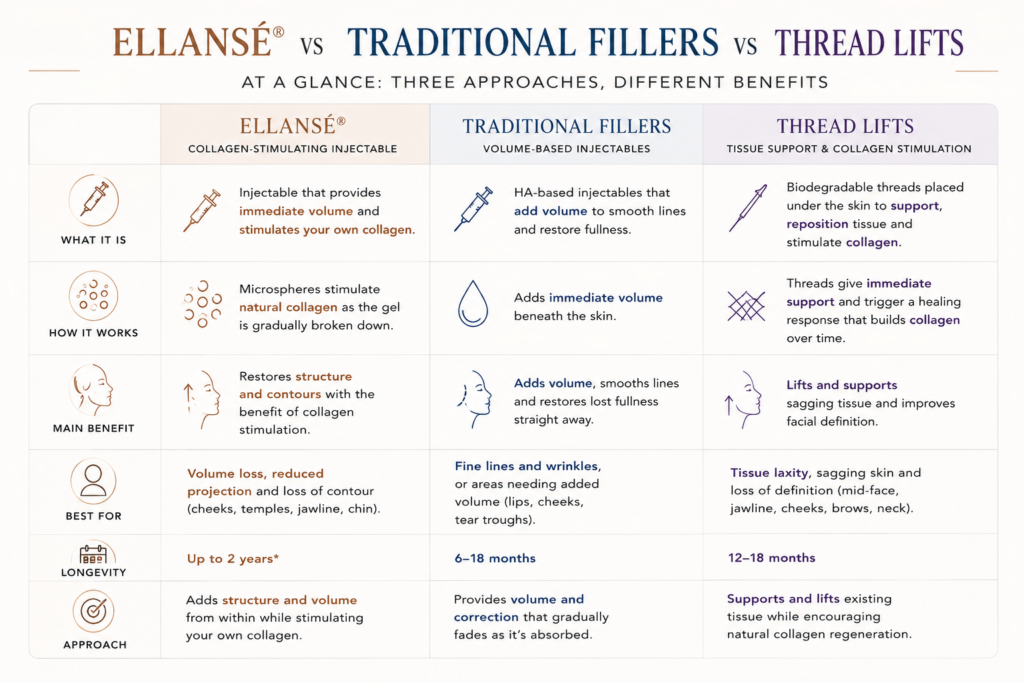
Initially, a carrier gel provides a degree of immediate correction, allowing changes in contour and structure to be seen relatively quickly. The second stage develops more gradually.
Ellansé contains tiny microspheres that encourage the body to produce new collagen around the treated area. As the carrier gel is gradually broken down, this collagen response contributes to the longer-term effect.
To understand why this matters, it helps to look at collagen itself. Collagen forms an important part of the skin’s structural framework, contributing to strength, firmness and support. We naturally produce less of it as we age, while existing collagen becomes less efficiently organised.
Encouraging collagen production therefore approaches facial ageing differently from simply placing a substance beneath a wrinkle to make it less visible. The aim is not only to provide correction, but also to encourage a response within the tissue itself.
Where Do Thread Lifts Fit into Facial Ageing?
Thread lifting addresses a different part of facial ageing: tissue position.
As the supporting structures of the face change over time, skin and underlying tissues can begin to descend, contributing to softer contours, early jowling and reduced definition. When this is the main concern, adding more volume may not address what is actually happening.
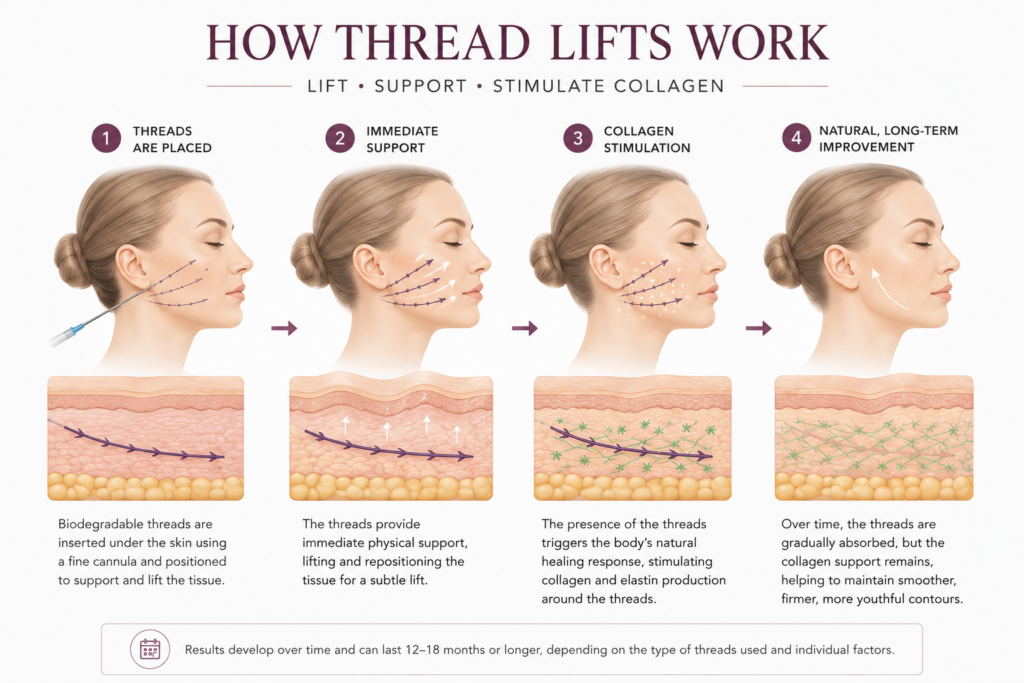
A Thread Lift is a minimally invasive treatment in which fine, biodegradable threads are carefully placed beneath the skin. Depending on the type of thread and how it is positioned, the threads can provide support to the tissues, improve facial contours and, in some cases, create a subtle lifting effect.
At Aesthetics Lab, thread treatments include PDO Mono Threads and Silhouette Soft. The two are used differently, which is why thread lifting should not be thought of as a single standardised treatment, or simply another form of filler.
There is also a longer-term biological effect. As the threads sit within the tissue, they create a controlled healing response that encourages fibroblasts to produce collagen around the treated area. The threads themselves gradually break down, while the collagen response develops over time.
Thread lifting therefore works on two levels: providing physical support where appropriate while also encouraging the skin’s own collagen-producing processes.
Can Ellansé and Thread Lifts Work Together?
Ellansé and thread lifts can be considered within the same overall strategy because they address different aspects of facial ageing. This does not mean, however, that combining treatments automatically produces a better result. Combination treatment makes most sense when there are multiple identifiable causes behind what the patient sees.
For example, structural change may be contributing to reduced facial definition while tissue laxity is adding to the effect. In that situation, correcting structure without considering tissue position may only address part of the problem. Equally, repositioning tissue without recognising genuine structural volume loss may have limitations.
We combine treatments because the anatomy requires different solutions, not because more treatment must mean more improvement. Treatment can also be staged. Addressing one component first and reassessing afterwards can make it easier to judge what, if anything, still needs attention.
Is Collagen Stimulation Replacing Traditional Fillers?
No. It is better viewed as an expansion of what aesthetic medicine can address.
There are situations where replacing volume with a traditional filler is entirely appropriate. There are others where tissue position, collagen decline or skin quality plays a larger role.
The important development is that facial rejuvenation no longer needs to be viewed simply as a choice between “having filler” and “doing nothing”. Instead, we can think more specifically about the changes taking place:
Is volume missing? Is support declining? Has tissue shifted? Is skin quality contributing?
Once those questions are separated, it becomes easier to understand why different faces, and even different areas of the same face, may benefit from very different approaches.
FAQs About Ellansé and Thread Lifts
Can previous filler affect whether I can have Ellansé?
It can influence treatment planning. A practitioner needs to know what has previously been injected, where it was placed and approximately when it was treated before deciding whether Ellansé is appropriate.
Is Ellansé the same as a skin booster?
No. Although collagen stimulation can influence tissue quality, Ellansé is used as a structural injectable rather than functioning in the same way as a treatment designed primarily to improve superficial skin hydration.
Can thread lifts change the shape of my face?
Thread placement can influence facial contours by supporting and repositioning selected tissues, but treatment should work with your existing facial proportions rather than attempting to create an entirely new facial shape.
Do collagen-stimulating treatments work equally well for everyone?
Individual biological responses vary. Age, skin quality, lifestyle, anatomy and the degree of existing facial change can all influence how someone responds to collagen stimulation.
Does having a thread lift make future aesthetic treatment more complicated?
It is important to tell any practitioner about previous thread treatments, including approximately when they were performed and which areas were treated. This allows future procedures to be planned with your treatment history in mind.
Why might a practitioner recommend doing nothing to one of my concerns?
Because the most visible feature is not always the feature that needs treating. Addressing another contributing factor may reduce its appearance, while treating it directly could add unnecessary volume or alter otherwise balanced proportions.
Looking at Facial Ageing Differently
Perhaps the biggest shift in modern facial rejuvenation is not a new injectable or technique. It is the way we think about the ageing face. A line does not automatically need filling. A softer jawline does not automatically require more product. And losing definition does not always mean losing volume. Understanding whether the underlying issue is structural change, collagen decline, tissue laxity or a combination of these factors allows treatment decisions to become much more precise.
For patients considering Ellansé or thread lifts in London, a detailed facial assessment can help identify which of these changes are contributing before deciding whether treatment is appropriate.
At Aesthetics Lab in Belgravia and Primrose Hill, consultations consider facial anatomy, skin quality and previous treatment history, helping to determine what has actually changed rather than focusing only on what is most noticeable in the mirror.
If you would like to better understand the changes you are seeing in your own face, you can book a consultation at Aesthetics Lab in Belgravia or Primrose Hill for an individual assessment and a discussion of the options that may be appropriate for you.